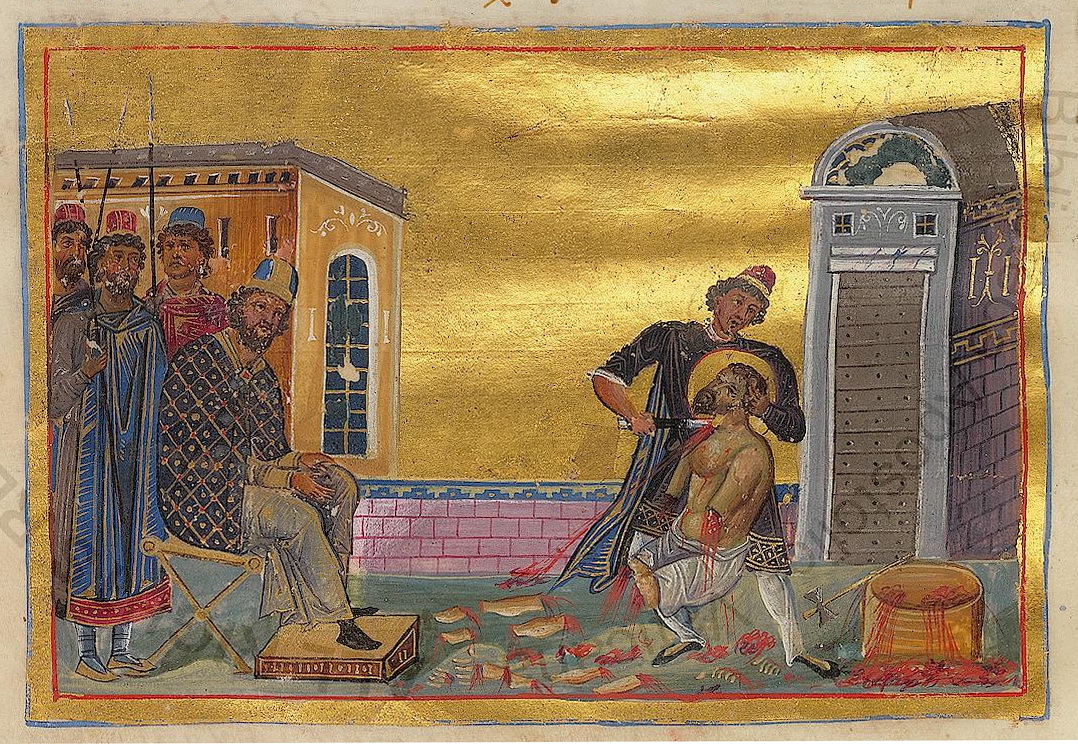
Image: The martyrdom of St. James the Persian (James Intercisus), Menologion of Basil II, Constantinople, about 985. Vatican Library (Vat. gr. 1613). Public domain, via Wikimedia Commons. (source)

Omnis ergo qui confitébitur me coram homínibus, confitébor et ego eum coram Patre meo, qui in cælis est.
Matthew 10:32
Every one therefore that shall confess me before men, I will also confess him before my Father who is in heaven.
About Today
On Friday, November 27, the 1962 calendar has no feast: it is the Friday after the twenty-fourth and last Sunday after Pentecost, a feria with green vestments, and it is a day of abstinence. The Ordo lists no commemoration. So today we honor a saint from the Roman Martyrology, which names St. James Intercisus on this day. The Mass is that of the preceding Sunday, as it is on most ferias at this season, and the Collect below is that Sunday’s, since the Martyrology saint has no Collect of his own.
His Life
St. James Intercisus, “James the Cut-to-Pieces,” was a Persian Christian who lived in the early fifth century. The old Acts of his martyrdom tell that he came of a noble Christian family and stood high in the favor of King Yazdegerd I, in whose service he lived at court. The Persian kings of that time were sometimes tolerant of Christians and sometimes fierce against them, and James’s life was bound up with the king’s moods.
When Yazdegerd turned against the Church, James did what many have done in a moment of fear: to keep the king’s friendship he denied Christ. The Roman Martyrology puts it plainly, that he denied Christ to win the favor of the king. It was not easy for him to bear what followed. His mother and his wife were still faithful Christians, and they would no longer live in his company; they sent him a letter reproaching him for having thrown away eternal life for the sake of a man who must himself soon die.
The reproach did its work. James came to himself, as the Martyrology says, and wept over what he had done. Yazdegerd died about the year 420, and his son Bahram V, called Vararanes in the Latin text, took the throne and renewed the persecution. When James was brought before the new king, he did not hide; he confessed openly and without fear that he was a Christian, and he would not take back his word.
The king was angered and condemned him to be put to death by cutting him apart, limb by limb, before his head was struck off. The Acts say that the executioners began with his fingers and toes and went on, joint by joint, and that James, lying in agony, prayed aloud through the whole of it, thanking God and asking for strength to hold out to the end. When it was done, his head was cut off. This is the cruel death that gave him his name, Intercisus, the one cut to pieces.
He died on November 27, in the year 421 according to the usual reckoning, and the Martyrology adds that countless other martyrs suffered in the same place and at the same time. The Latin Church names him on this day, and the Eastern Churches also honor him as James the Persian. His story is a hard one, and a hopeful one: he fell, he rose, and the grace of God held him to the end. He reminds us that a Christian who has failed is not lost if he turns back to Christ.
Patronage and Sacred Art
No widely recognized patronage is recorded for St. James Intercisus. In art, especially in Eastern Christian art, he is shown as a martyr whose limbs have been severed, and the pieces are often shown on the ground around him. The picture above is a miniature from the Menologion of Basil II, a book of saints’ lives made at Constantinople about the year 985 and now in the Vatican Library. It shows the haloed saint with the executioner, and a ruler seated at the left, watching.
A Lesson for Today
St. James teaches us that a fall is not the end. Fear led him to deny Christ, and the loving rebuke of his mother and wife turned him back. If we have failed, we can begin again today, and we can be that kind of voice for someone else, speaking the truth gently so that a friend may return to God.
The Mass of the Day
Introit (Jeremias 29:11, 12, 14; Psalm 84:2)
Dicit Dóminus: Ego cógito cogitatiónes pacis, et non afflictiónis: invocábitis me, et ego exáudiam vos: et redúcam captivitátem vestram de cunctis locis. Ps. Benedixísti, Dómine, terram tuam: avertísti captivitátem Jacob. Glória Patri. Dicit Dóminus: Ego cógito cogitatiónes pacis, et non afflictiónis: invocábitis me, et ego exáudiam vos: et redúcam captivitátem vestram de cunctis locis.
The Lord says: I think thoughts of peace, and not of affliction. You shall call upon Me, and I will hear you; and I will bring back your captivity from all places. Ps. You have favored, O Lord, Your land; You have restored the well-being of Jacob. Glory be to the Father. The Lord says: I think thoughts of peace, and not of affliction. You shall call upon Me, and I will hear you; and I will bring back your captivity from all places.
Collect
Latin
Excita, quǽsumus, Dómine, tuórum fidélium voluntátes: ut, divíni óperis fructum propénsius exsequéntes; pietátis tuæ remédia majóra percípiant. Per Dóminum nostrum Iesum Christum Fílium tuum, qui tecum vivit et regnat in unitáte Spíritus Sancti, Deus, per ómnia sǽcula sæculórum. Amen.
English
Arouse, we beseech Thee, O Lord, the wills of Thy faithful people: that, by a more earnest search for the fruit of Thy divine work, they may receive more abundantly of the healing effects of Thy goodness. Through our Lord Jesus Christ, Thy Son, who liveth and reigneth with Thee in the unity of the Holy Ghost, God, world without end. Amen.
Epistle: Colossians 1:9-14
Léctio Epístolæ beáti Pauli Apóstoli ad Colossénses. Fratres: Non cessámus pro vobis orántes et postulántes, ut impleámini agnitióne voluntátis Dei, in omni sapiéntia et intelléctu spiritáli: ut ambulétis digne Deo per ómnia placéntes: in omni ópere bono fructificántes, et crescéntes in scientia Dei: in omni virtúte confortáti secúndum poténtiam claritátis ejus in omni patiéntia, et longanimitáte cum gáudio, grátias agentes Deo Patri, qui dignos nos fecit in partem sortis sanctórum in lúmine.
Brethren: We have been praying for you unceasingly, asking that you may be filled with knowledge of God’s will, in all spiritual wisdom and understanding. May you walk worthily of God and please Him in all things, bearing fruit in every good work and growing in the knowledge of God. May you be completely strengthened through His glorious power unto perfect patience and long-suffering; joyfully rendering thanks to God the Father, Who has made us worthy to share the lot of the saints in light.
Gospel: Matthew 24:15-22
In illo témpore: Dixit Jesus discípulis suis: Cum vidéritis abominatiónem desolatiónis, quæ dicta est a Daniéle Prophéta, stantem in loco sancto: qui legit, intélligat: tunc qui in Judǽa sunt, fúgiant ad montes: et qui in tecto, non descéndat tóllere áliquid de domo sua: et qui in agro, non revertátur tóllere túnicam suam. Væ autem prægnántibus et nutriéntibus in illis diébus. Oráte autem, ut non fiat fuga vestra in híeme vel sábbato. Erit enim tunc tribulátio magna, qualis non fuit ab inítio mundi usque modo, neque fiet.
At that time, Jesus said to His disciples: When you see the abomination of desolation, which was spoken of by Daniel the prophet, standing in the holy place – let him who reads understand – then let those who are in Judea flee to the mountains; and let him who is on the housetop not go down to take anything from his house; and let him who is in the field not turn back to take his cloak. But woe to those who are with child, or have infants at the breast in those days! But pray that your flight may not be in the winter, or on the Sabbath. For then there will be great tribulation, such as has not been from the beginning of the world until now, nor will be.
Sancte Iacóbe, ora pro nobis.
St. James, pray for us.
Roman Martyrology
Antiochíæ sanctórum Mártyrum Basiléi Epíscopi, Auxílii et Saturníni.
At Antioch, the holy martyrs Basil, bishop, Auxilius and Saturninus.
Sebáste, in Arménia, sanctórum Mártyrum Hirenárchi, Acácii Presbýteri, ac septem mulíerum. Harum porro constántia Hirenárchus commótus, ad Christum convérsus, sub Diocletiáno Imperatóre et Máximo Prǽside, una cum Acácio, secúri percútitur.
At Sebaste, in Armenia, the holy martyrs Hirenarchus, Acacius, a priest, and seven women. Moved by the constancy of these women, Hirenarchus was converted to Christ, and under the Emperor Diocletian and the governor Maximus he was put to death with the axe, together with Acacius.
Apud Cæam flúvium, in Gallǽcia, sanctórum Facúndi et Primitívi, qui sub Attico Prǽside passi sunt.
By the river Ceas, in Galicia, the holy martyrs Facundus and Primitivus, who suffered under the governor Atticus.
In Pérside sancti Iacóbi intercísi, Mártyris conspícui, qui, témpore Theodósii iunióris, cum in Isdegérdis Regis grátiam Christum negásset, et proptérea mater eius et uxor ab ipsíus se consuetúdine subtraxíssent, hinc, in se revérsus, intrépide coram Vararáne, Isdegérdis fílio ac successóre, se Christiánum esse conféssus est; ideóque ab iráto Rege, lata in eum mortis senténtia, membrátim iussus est concídi et cápite obtruncári. Quo étiam témpore innúmeri álii Mártyres ibídem passi sunt.
In Persia, St. James Intercisus, a famous martyr, who in the time of Theodosius the Younger had denied Christ to win the favor of King Yazdegerd, and for that reason his mother and his wife withdrew from his company. Coming to himself, he fearlessly confessed before Vararanes, the son and successor of Yazdegerd, that he was a Christian; and so, the angry king having passed sentence of death upon him, he was ordered to be cut to pieces limb by limb and then beheaded. At that same time countless other martyrs suffered in the same place.
Aquiléiæ sancti Valeriáni Epíscopi.
At Aquileia, St. Valerian, bishop.
Apud Régium, in Gállia, sancti Máximi, Epíscopi et Confessóris; qui, usque a primǽvæ ætátis annis omni virtútum grátia prǽditus, primum Lirinénsis cœnóbii Pater, deínde Regiénsis Ecclésiæ Epíscopus, signis et prodígiis ínclytus éxstitit.
At Riez, in Gaul, St. Maximus, bishop and confessor; adorned from his earliest years with every grace of virtue, first Father of the monastery of Lerins and then Bishop of the Church of Riez, he was renowned for signs and wonders.
Salisbúrgi, in Nórico, sancti Virgílii, Epíscopi et Carinthiórum Apóstoli, qui a Gregório Nono, Pontífice Máximo, in Sanctórum númerum adscríptus est.
At Salzburg, in Noricum, St. Virgil, bishop and Apostle of the Carinthians, who was numbered among the Saints by Pope Gregory IX.
Apud Indos, Persis finítimos, sanctórum Bárlaam et Iósaphat, quorum actus mirándos sanctus Ioánnes Damascénus conscrípsit.
Among the Indians, near the Persians, the holy Barlaam and Josaphat, whose wonderful deeds St. John Damascene wrote down.
Lutétiæ Parisiórum deposítio sancti Severíni, Mónachi et Solitarii.
At Paris, the burial of St. Severinus, monk and hermit.
Et álibi aliórum plurimórum sanctórum Mártyrum et Confessórum, atque sanctárum Vírginum.
And elsewhere many other holy martyrs, confessors and virgins.
Also honored today: St. Virgil, bishop and Apostle of the Carinthians, St. Maximus, bishop and confessor, and St. Severinus, monk and hermit.