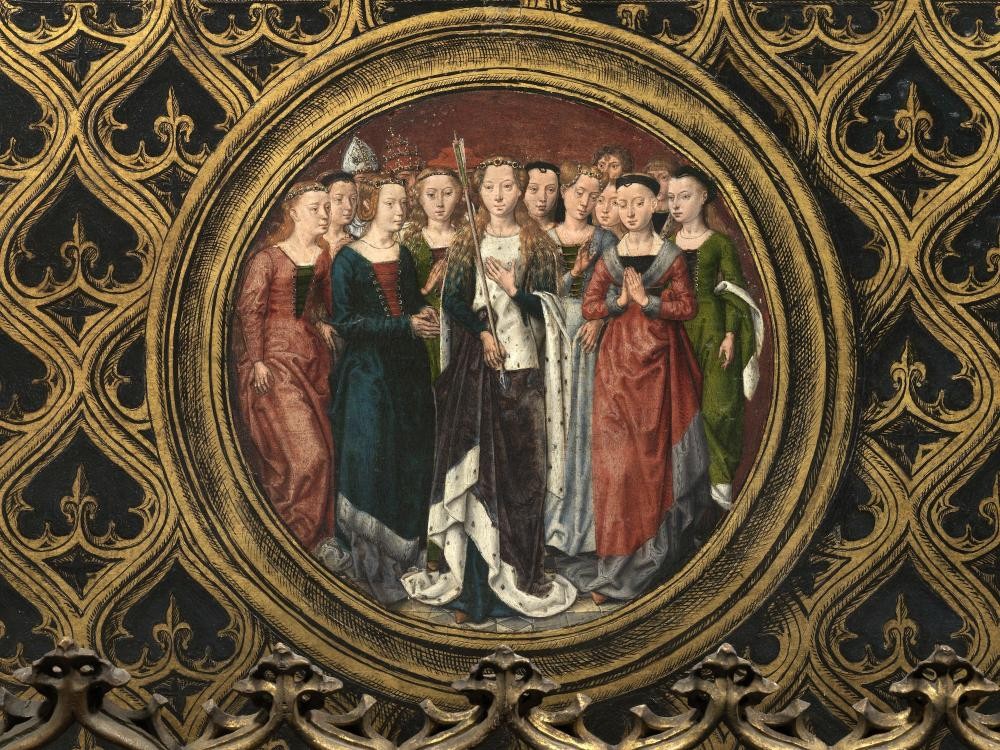
Image: Hans Memling, St. Ursula and her companion virgins, painted medallion from the roof of the Shrine of St. Ursula, 1489. Sint-Janshospitaal (Memling Museum), Bruges. Public domain.
This site follows the traditional Roman calendar of 1962, as found in the 1962 Roman Missal used at the Traditional Latin Mass. Some feast days fall on different dates than in the General Roman Calendar of 1969, revised after the Second Vatican Council.
Os justi meditabitur sapientiam, et lingua ejus loquetur judicium.
Psalm 36:30
The mouth of the just shall meditate wisdom, and his tongue shall speak judgment.
St. Hilarion
Hilarion was born about the year 291 at Tabatha, a village near Gaza in Palestine, to pagan parents. Sent as a boy to study at Alexandria, he excelled in learning and character, and there he came to believe in Jesus Christ. He was often in church, devoted to fasting and prayer, and indifferent to the pleasures that drew other young men.
Hearing of the fame of St. Anthony, he went into the Egyptian desert to see him, and stayed two months learning the hermit’s way of life. On returning home he found his parents dead, gave his inheritance to the poor, and, not yet fifteen years old, went back into the wilderness near Gaza. There he built a tiny hut, scarcely large enough to hold him, and slept on the ground. He lived on a few figs and the juice of herbs, never eating before sunset, and spent his days reading and pondering the Holy Scriptures.
By humility and continual prayer he overcame many fierce temptations of the devil, and God worked many miracles through him, especially the casting out of evil spirits. Disciples gathered around him, and monasteries grew up across Palestine, so that he is honoured as the father of monastic life in that land. Fleeing the crowds his fame attracted, he wandered to Egypt, Sicily, Dalmatia and finally Cyprus, always seeking solitude.
He died on Cyprus about the year 371, at the age of eighty. St. Jerome, who wrote his life, records his last words as he struggled with death: “Go forth, my soul, what do you fear? Go forth; why do you hesitate? For nearly seventy years you have served Christ, and are you afraid to die?”
St. Ursula and Companions
Today the Church also commemorates St. Ursula and her companions, virgins and martyrs, venerated since ancient times at Cologne on the Rhine. An inscription in the church built over their tomb tells of a company of holy virgins who were put to death there for Christ in the early centuries of the Church. Later tradition made Ursula a Christian princess from Britain who, returning from a pilgrimage with her companions, was slain with them by the Huns at Cologne rather than give up her faith and her consecration to God.
Their story became one of the best loved of the Middle Ages, painted by masters such as Hans Memling, whose shrine of St. Ursula in Bruges is shown above. St. Ursula is the patroness of the Ursuline Sisters, founded by St. Angela Merici for the Christian education of girls.
Collect
Latin
Intercessio nos, quaesumus, Domine, beati Hilarionis Abbatis commendet: ut, quod nostris meritis non valemus, ejus patrocinio assequamur. Per Dominum nostrum Jesum Christum, Filium tuum, qui tecum vivit et regnat in unitate Spiritus Sancti, Deus, per omnia saecula saeculorum. Amen.
Commemoratio Ss. Ursulae et Sociarum: Da nobis, quaesumus, Domine Deus noster, sanctarum Virginum et Martyrum tuarum Ursulae et Sociarum ejus palmas incessabili devotione venerari: ut, quas digna mente non possumus celebrare, humilibus saltem frequentemus obsequiis. Per Dominum nostrum.
English
May the intercession of blessed Hilarion, the Abbot, commend us to Thee, O Lord, we beseech Thee, that what we cannot obtain by our own merits we may gain through his patronage. Through our Lord Jesus Christ, Thy Son, who liveth and reigneth with Thee in the unity of the Holy Ghost, God, world without end. Amen.
Commemoration of St. Ursula and Companions: Grant us, we beseech Thee, O Lord our God, to venerate with unceasing devotion the victories of Thy holy Virgins and Martyrs, Ursula and her companions; that, though we cannot honour them as they deserve, we may at least offer them our humble homage. Through our Lord.
Sancte Hilarion, Sancta Ursula cum Sociis, orate pro nobis.
St. Hilarion, St. Ursula and companions, pray for us.