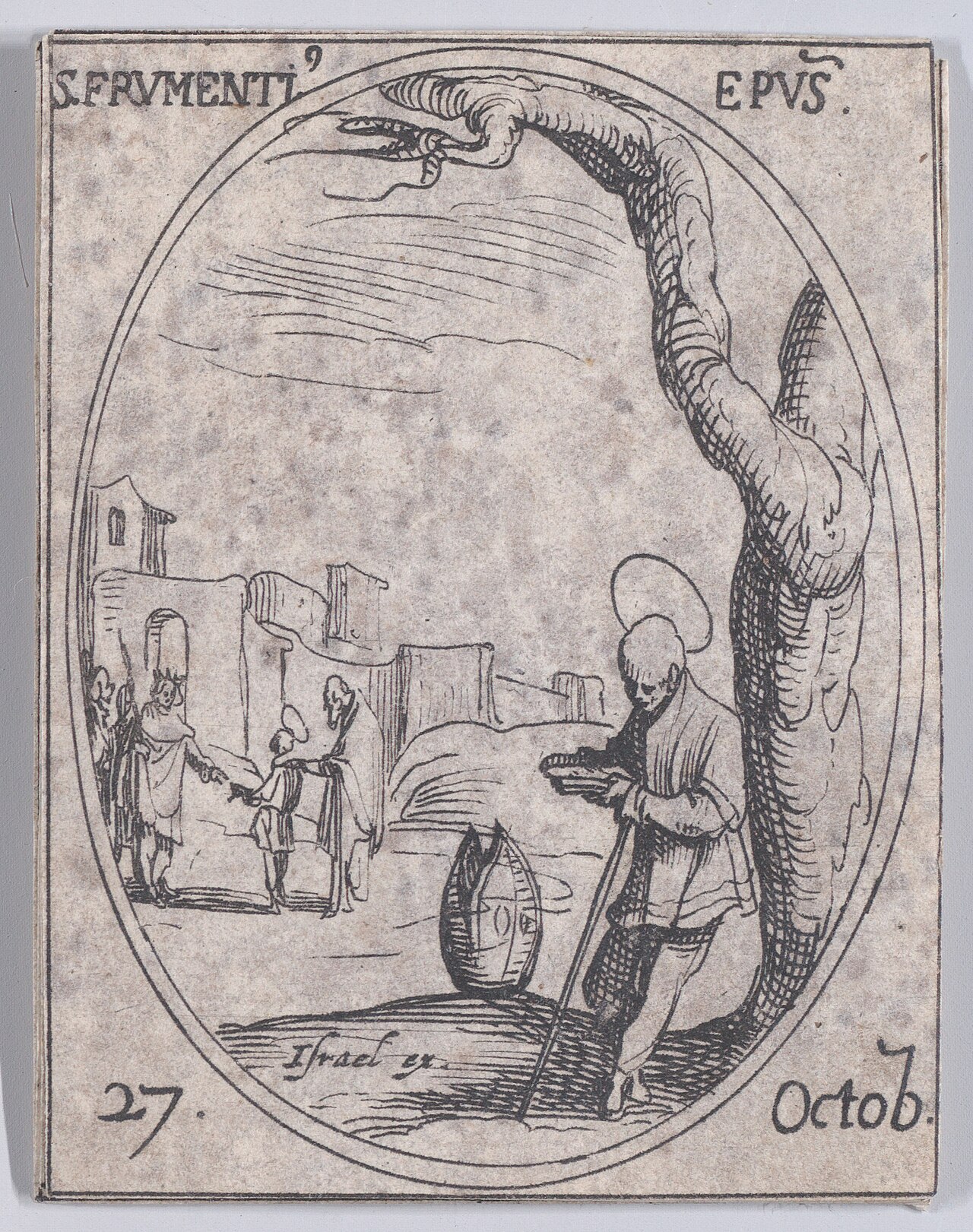
Image: Jacques Callot, St. Frumentius, Bishop, from Les Images de tous les saints, published 1636. Metropolitan Museum of Art. Public domain (Met Open Access, CC0), via Wikimedia Commons. (source)

This site follows the traditional Roman calendar of 1962, as found in the 1962 Roman Missal used at the Traditional Latin Mass. Some feast days fall on different dates than in the General Roman Calendar of 1969, revised after the Second Vatican Council.
Quam speciosi pedes evangelizantium pacem, evangelizantium bona!
Romans 10:15
How beautiful are the feet of them that preach the gospel of peace, of them that bring glad tidings of good things!
A Feria
In the traditional 1962 calendar, October 27 is a feria: no saint’s feast is kept at Mass today (the old Vigil of Sts. Simon and Jude was dropped in the 1960 reform), and the Mass is that of the preceding Sunday. So that every day has its saint, today’s entry comes from the traditional Roman Martyrology, which reads: “In India, St. Frumentius, bishop. While he was a captive there he was consecrated bishop by St. Athanasius, and preached the Gospel in that country.” The “India” of the old writers here means the kingdom of Aksum, in what is now Ethiopia.
His Life
Frumentius was a Christian boy from Tyre, in Phoenicia, in the early fourth century. With his brother Aedesius he sailed on the Red Sea in the company of their teacher, the philosopher Meropius. When their ship put in at an African port, the local people killed the crew and passengers, sparing only the two boys, who were taken as captives to the king of Aksum.
The brothers won the king’s trust. Aedesius became his cupbearer and Frumentius, the wiser of the two, his secretary and keeper of records. When the king died, the widowed queen begged them to stay and help govern until her young son, Ezana, came of age. Frumentius used his place at court to seek out Christian merchants from Roman lands, gave them freedom to worship, helped them build places of prayer, and quietly spread the Faith among the people.
When the prince was grown, the brothers were set free. Aedesius returned to Tyre, but Frumentius went to Alexandria and asked the great St. Athanasius to send a bishop to the land he had come to love. Athanasius answered that no one was better fitted than Frumentius himself, and consecrated him bishop around the year 340. He went back to Aksum, baptized many, and by tradition King Ezana himself embraced Christianity. The Ethiopian Church still honors him as Abuna Salama, “Father of Peace,” and as the one who first brought them the light of the Gospel.
Collect
Latin
Da, quǽsumus, omnípotens Deus: ut beáti Fruméntii Confessóris tui atque Pontíficis veneránda solémnitas, et devotiónem nobis áugeat et salútem. Per Dominum nostrum Jesum Christum, Filium tuum, qui tecum vivit et regnat in unitate Spiritus Sancti, Deus, per omnia sæcula sæculorum. Amen.
English
Grant, we beseech Thee, almighty God, that the venerable feast of blessed Frumentius, Thy Confessor and Bishop, may increase in us both devotion and salvation. Through our Lord Jesus Christ, Thy Son, who liveth and reigneth with Thee in the unity of the Holy Ghost, God, world without end. Amen.
Sancte Frumenti, ora pro nobis.
St. Frumentius, pray for us.