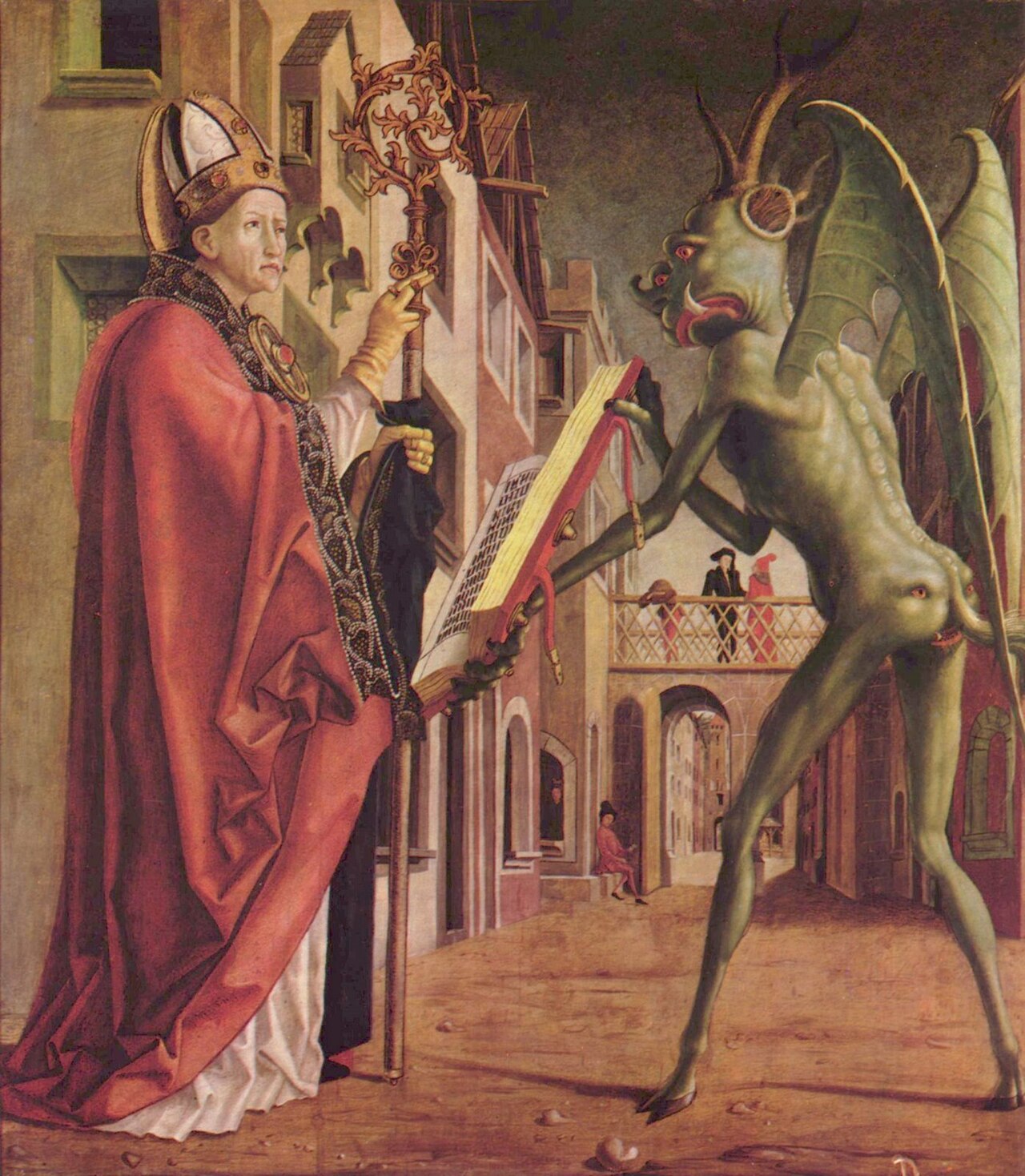
Image: Michael Pacher, Saint Wolfgang and the Devil, from the Altarpiece of the Church Fathers, 1471–1475. Alte Pinakothek, Munich. Public domain, via Wikimedia Commons. (source)

This site follows the traditional Roman calendar of 1962, as found in the 1962 Roman Missal used at the Traditional Latin Mass. Some feast days fall on different dates than in the General Roman Calendar of 1969, revised after the Second Vatican Council.
Bonus pastor animam suam dat pro ovibus suis.
John 10:11
The good shepherd giveth his life for his sheep.
A Feria
In the traditional 1962 calendar, October 31 is a feria: no saint’s feast is kept at Mass today. For centuries this day was the Vigil of All Saints, but that vigil was removed from the calendar in 1955. So that every day has its saint, today’s entry comes from the traditional Roman Martyrology, which reads: “At Ratisbon, St. Wolfgang, bishop.”
His Life
Wolfgang was born around the year 924 in Swabia, in southern Germany. As a boy he was sent to study at the famous abbey school of Reichenau, and later at Würzburg. A gifted student, he went on to teach at the cathedral school of Trier, where he worked to raise the standard of learning and discipline among the clergy.
Wanting a life given wholly to God, he became a Benedictine monk at the abbey of Einsiedeln, in what is now Switzerland, and there he was ordained a priest by St. Ulric, Bishop of Augsburg. Soon after, he set out as a missionary to the Magyars of Pannonia, a fierce people who had only recently stopped raiding the Christian lands to the west.
In 972 he was named Bishop of Ratisbon, today’s Regensburg in Bavaria. He kept his monk’s habit and his simple way of life, and he spent the revenues of his diocese on the poor. He preached tirelessly, visited his parishes, corrected careless priests, and restored strict observance in the monasteries, especially the great abbey of St. Emmeram. For the good of souls he willingly gave up part of his own territory so that Bohemia could have its own bishop at Prague.
He was also entrusted with the education of the young Duke Henry of Bavaria, who later became the holy Emperor St. Henry II. For a time Wolfgang withdrew to live as a hermit beside a lake in the Austrian mountains, a place that still bears his name. Old stories tell how he outwitted the devil there, which is the scene in today’s painting.
Called back to his flock, he continued his labours until, while travelling on the Danube, he fell ill and died at Pupping, near Linz, on October 31, 994. He was canonized by Pope St. Leo IX in 1052, and he is still loved in Bavaria and Austria as a true shepherd of his people.
Collect
Latin
Da, quǽsumus, omnípotens Deus: ut beáti Wolfgángi Confessóris tui atque Pontíficis veneránda solémnitas, et devotiónem nobis áugeat et salútem. Per Dominum nostrum Jesum Christum, Filium tuum, qui tecum vivit et regnat in unitate Spiritus Sancti, Deus, per omnia sæcula sæculorum. Amen.
English
Grant, we beseech Thee, almighty God, that the venerable festival of blessed Wolfgang, Thy Confessor and Bishop, may increase in us both devotion and salvation. Through our Lord Jesus Christ, Thy Son, who liveth and reigneth with Thee in the unity of the Holy Ghost, God, world without end. Amen.
Sancte Wolfgange, ora pro nobis.
St. Wolfgang, pray for us.