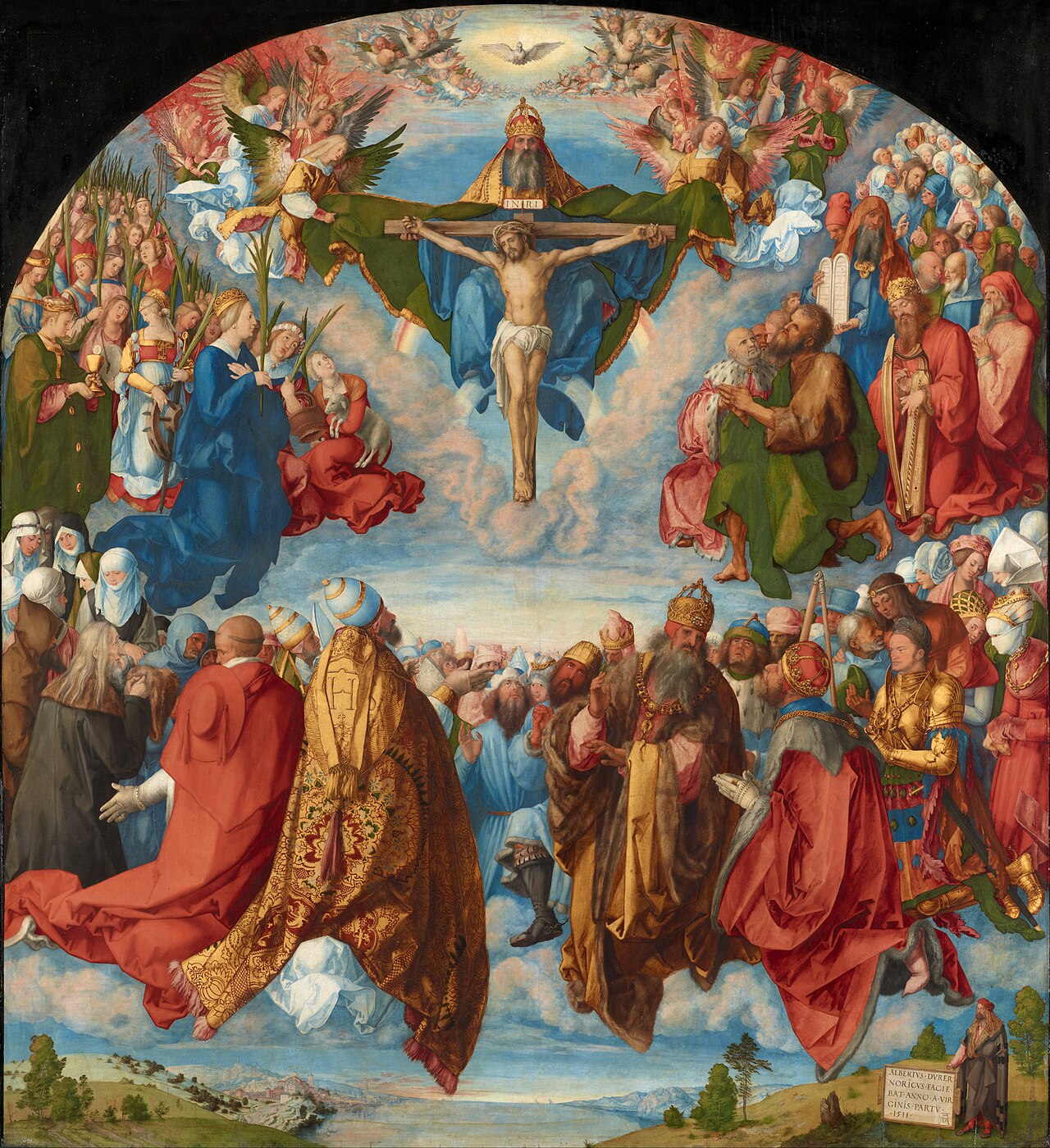
Image: Albrecht Dürer, Adoration of the Trinity (Landauer Altar), 1511. Kunsthistorisches Museum, Vienna. Public domain, via Wikimedia Commons. (source)

This site follows the traditional Roman calendar of 1962, as found in the 1962 Roman Missal used at the Traditional Latin Mass. Some feast days fall on different dates than in the General Roman Calendar of 1969, revised after the Second Vatican Council.
Vidi turbam magnam, quam dinumerare nemo poterat, ex omnibus gentibus… amicti stolis albis, et palmæ in manibus eorum.
Apocalypse 7:9
I saw a great multitude, which no man could number, of all nations… clothed with white robes, and palms in their hands.
The Feast
Today the Church keeps the Feast of All Saints, a feast of the first class in the traditional 1962 calendar. Because of its high rank it takes the place of this Sunday’s Mass. On this one day she honors every soul who has reached heaven: the great martyrs, doctors, virgins and confessors whose names fill the calendar, and also the countless holy men, women and children whose names are known to God alone.
Its History
In the early centuries the Christians of the East kept a common feast of all the martyrs. In Rome, on May 13 in the year 609 or 610, Pope Boniface IV dedicated the ancient pagan temple of the Pantheon as a church in honor of the Blessed Virgin Mary and all the martyrs. A century later Pope Gregory III consecrated a chapel in St. Peter’s Basilica to all the Saints, and Pope Gregory IV extended the feast, now kept on November 1, to the whole Church in the ninth century.
Its Meaning
The Epistle of today’s Mass, taken from the Apocalypse of St. John, shows a vast crowd from every nation standing before the throne of God and of the Lamb, dressed in white and holding palms of victory. The Gospel gives the Beatitudes, the road every one of them walked: poverty of spirit, meekness, mourning, hunger for justice, mercy, purity of heart, peacemaking, and patience under persecution.
The feast reminds us of the Communion of Saints. Those in heaven are not far away; they know us, love us, and pray for us. Their example shows that holiness is possible in every age and state of life, and their company is the home to which we are all called. Tomorrow the Church turns in prayer to the holy souls in Purgatory on All Souls’ Day.
Collect
Latin
Omnípotens sempitérne Deus, qui nos ómnium Sanctórum tuórum mérita sub una tribuísti celebritáte venerári: quǽsumus; ut desiderátam nobis tuæ propitiatiónis abundántiam, multiplicátis intercessóribus, largiáris. Per Dóminum nostrum Jesum Christum, Fílium tuum, qui tecum vivit et regnat in unitáte Spíritus Sancti, Deus, per ómnia sǽcula sæculórum. Amen.
English
Almighty and everlasting God, who hast granted us to honor in one solemn festival the merits of all Thy Saints: we beseech Thee that, as our intercessors are multiplied, Thou wouldst bestow upon us the desired abundance of Thy mercy. Through our Lord Jesus Christ, Thy Son, who liveth and reigneth with Thee in the unity of the Holy Ghost, God, world without end. Amen.
Omnes Sancti et Sanctæ Dei, intercedite pro nobis.
All ye holy men and women, Saints of God, intercede for us.