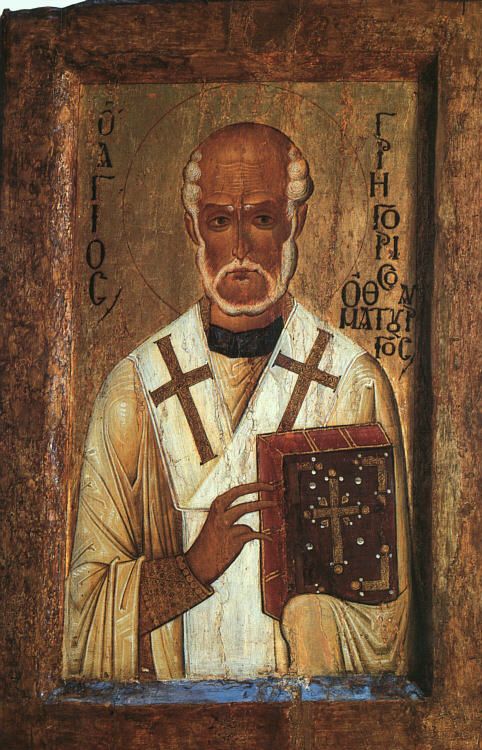
Image: Icon of St. Gregory Thaumaturgus. Public domain, via Wikimedia Commons. (source)

Si habuéritis fidem sicut granum sinápis, dicétis monti huic: Transi hinc illuc, et transíbit.
Matthew 17:19
If you have faith as a grain of mustard seed, you shall say to this mountain, Remove from hence hither, and it shall remove.
About Today
On November 17 the 1962 calendar keeps the feast of St. Gregory the Wonderworker, Bishop and Confessor, a feast of the third class, with white vestments. The Mass is taken from the Common of Confessors who were Bishops, and the Gospel speaks of the faith that can move a mountain.
His Life
Gregory was born about the year 213 at Neocaesarea in Pontus, in Asia Minor, into a pagan family of standing. He was first called Theodore, “gift of God.” His father died when the boy was fourteen. With his brother Athenodorus he was trained in rhetoric and in law, and the two young men set out to study at the famous law school of Beirut.
On the way they accompanied their sister to Caesarea in Palestine, where her husband had received an official post. There they heard the great Christian teacher Origen, and they remained as his pupils for some seven years, from about 231. Origen won them to the Faith and formed them in Scripture and in philosophy. Gregory later wrote a farewell address of thanksgiving to his master, which still survives.
He returned to Pontus intending, it seems, to practice law. Instead he was consecrated bishop of his native city by Phaedimus, Bishop of Amasea, though the Christian flock there was then very small. An ancient tradition, recorded by St. Gregory of Nyssa, says that only seventeen Christians lived in Neocaesarea when he came.
Before taking up his charge he withdrew for a time to pray. St. Gregory of Nyssa, whose grandmother St. Macrina the Elder handed down this memory, relates that the Blessed Virgin and the Apostle St. John appeared to him, and that St. John gave him a short confession of the Faith concerning the Holy Trinity, a creed long preserved in the church of Neocaesarea.
Many wonders were told of him, and these earned him the name Thaumaturgus, “the Wonderworker.” St. Gregory of Nyssa recounts that, by prayer, he caused a mountain to yield room for a church, and that he planted his staff on the bank of the river Lycus and asked God to set a bound the flood would not cross; the staff took root and became a tree, and the river kept that limit. He also tells of a lake that was turned to dry land, ending a quarrel between two brothers, and of demons that fled at the bishop’s word. Not every tale can be taken just as it stands, yet the Church has always honored him as a man of great faith and of power in prayer.
He guided his people through the persecution of the emperor Decius, about the year 250, advising them to seek safety, and he himself withdrew for a time into the wilderness with his deacon. In later years, after barbarian tribes had swept through Pontus, he cared for his wounded flock and left a Canonical Letter for the healing of the Church’s life. He died at Neocaesarea about 270. The same tradition that counted seventeen Christians at his coming says that only seventeen pagans remained in the city when he died.
Patronage and Sacred Art
He is traditionally invoked against floods and earthquakes, in memory of the wonders told of him by the river Lycus and of the church he built, which later ages said was spared when an earthquake threw down the buildings around it. In Christian art he is almost always shown as a bishop, most often in the manner of an Eastern icon, wearing episcopal vestments and sometimes holding a Gospel book. Some images recall the driving of a demon from a temple, or his part in the calling of St. Alexander of Comana. A well-known Byzantine icon of him, painted in the twelfth century, is kept at the Hermitage in St. Petersburg.
A Lesson for Today
Gregory’s power came from a faith that trusted God completely. We may never move mountains, but a small and steady faith, lived faithfully each day, can still move hearts, beginning with our own.
Collect
Latin
Da, quǽsumus, omnípotens Deus: ut beáti Gregórii Confessóris tui atque Pontíficis veneránda solémnitas, et devotiónem nobis áugeat et salútem. Per Dóminum nostrum Iesum Christum, Fílium tuum, qui tecum vivit et regnat in unitáte Spíritus Sancti, Deus, per ómnia sǽcula sæculórum. Amen.
English
Grant, we beseech Thee, almighty God, that the venerable feast of blessed Gregory, Thy Confessor and Bishop, may increase our devotion and promote our salvation. Through our Lord Jesus Christ, Thy Son, who liveth and reigneth with Thee in the unity of the Holy Ghost, God, world without end. Amen.
Sancte Gregori, ora pro nobis.
St. Gregory, pray for us.