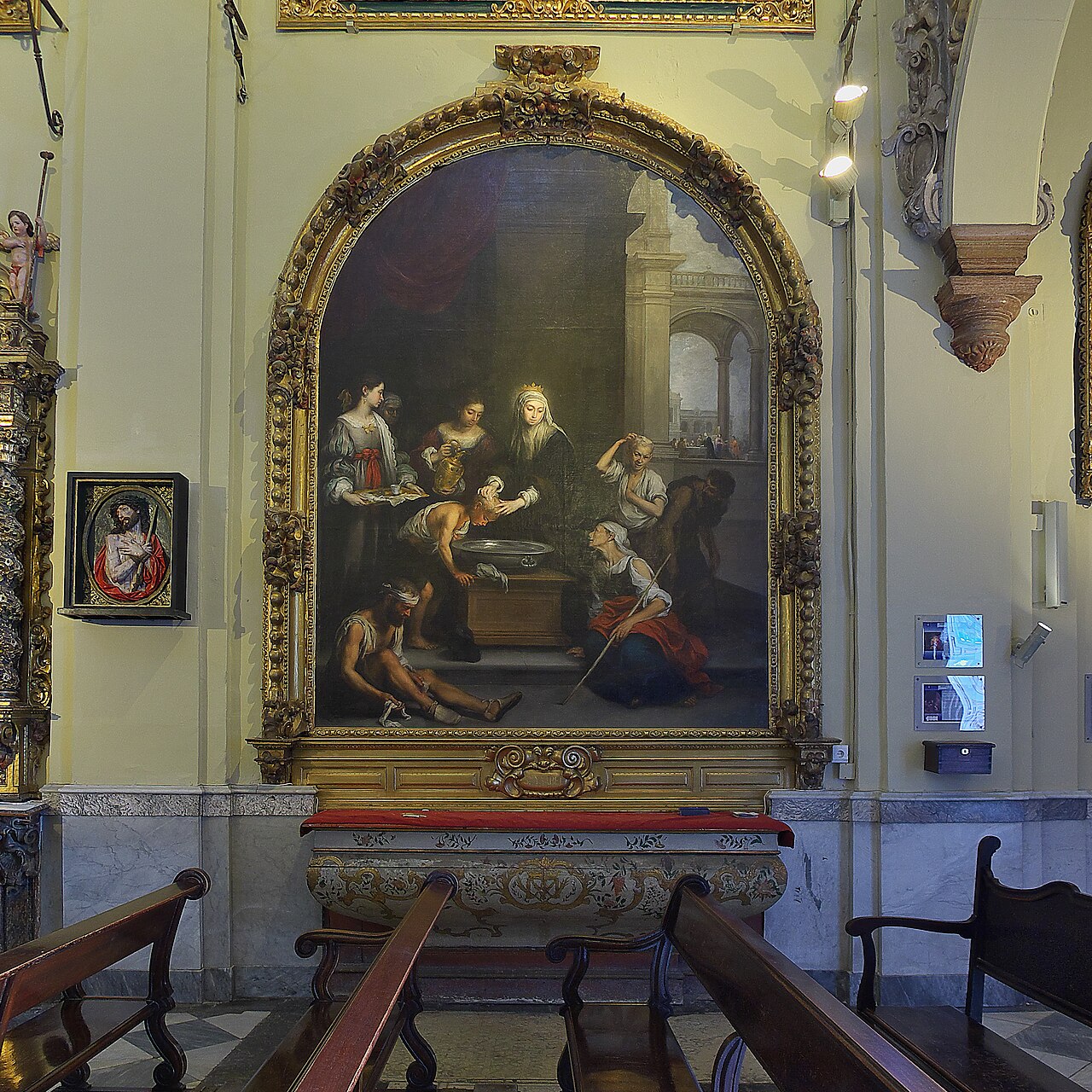
Image: Bartolomé Esteban Murillo, St. Elizabeth of Hungary Tending the Sick (c. 1672), Hospital de la Caridad, Seville. Public domain, via Wikimedia Commons. (source)

Manum suam apéruit ínopi, et palmas suas exténdit ad páuperem.
Proverbs 31:20
She hath opened her hand to the needy, and stretched out her hands to the poor.
About Today
On November 19 the 1962 calendar keeps the feast of St. Elizabeth of Hungary, Widow, a feast of the third class, with white vestments. The Mass is from the Common of Holy Women, “Cognovi,” and a commemoration is made of St. Pontianus, Pope and Martyr. The Epistle of the day is the praise of the valiant woman from the Book of Proverbs, which fits this royal servant of the poor so well.
Her Life
Elizabeth was born in 1207, a daughter of King Andrew II of Hungary and his queen Gertrude of Andechs-Meran. As was the custom among royal families, she was promised in marriage while still a small child to the son of Hermann, Landgrave of Thuringia, and at about four years old she was sent to be raised at his court at the Wartburg castle in Germany. Even as a girl she was drawn to prayer and to the chapel, and she cared little for the games and finery of the court, which earned her the scorn of some of its members.
In 1221, at the age of fourteen, she married Louis, who had become Landgrave of Thuringia. Theirs was a marriage of real affection and shared faith. Louis encouraged her charity and defended her when others complained that she gave away too much. They had three children: Hermann, Sophia, and Gertrude. Elizabeth rose at night to pray, dressed simply when her husband was away, and refused food at table that she knew had been taken unjustly from the peasants.
The first Franciscan friars had come to Germany in her lifetime, and Elizabeth eagerly embraced the spirit of poverty of St. Francis of Assisi. During a terrible famine in 1226, while Louis was in Italy, she opened the granaries of the castle and gave out grain to the hungry. Below the Wartburg she built a hospital where she herself nursed the sick, and she fed hundreds of the poor each day at the castle gate. A well-known legend says that once, when she was carrying bread to the poor in her cloak, she was stopped and asked what she held; when the cloak was opened, it was full of roses.
In 1227 Louis set out with the Emperor Frederick II on crusade, but he fell ill and died at Otranto in southern Italy. When the news reached her, Elizabeth cried out that the world with all its joys was now dead to her. Not long afterward she left the Wartburg with her children. The old accounts say that her husband’s relatives drove her out; however it came about, she knew real hardship and humiliation and bore it with patience, even having a Te Deum sung in thanksgiving for her trials.
Under the strict direction of her confessor, Master Conrad of Marburg, she gave up her rank and her goods. On Good Friday of 1228 she laid aside the world and took the grey habit of the Third Order of St. Francis. At Marburg she used her dowry to build a hospital in honor of St. Francis, and there she spent her remaining strength washing, feeding, and nursing the poorest and most repulsive of the sick, spinning wool to earn her own bread.
Worn out by penance and labor, Elizabeth died at Marburg on the night of November 16 to 17, 1231, only twenty-four years old. Many miracles were reported at her tomb, and Pope Gregory IX canonized her in 1235, scarcely four years after her death. The great Gothic church of St. Elizabeth at Marburg was raised over her grave, and she has been loved ever since in Hungary, Germany, and throughout the Church as the model of Christian charity in high station.
Patronage and Sacred Art
St. Elizabeth is a patroness of the Third Order of St. Francis, of hospitals, nurses, and charitable works, of bakers, and of widows. In art she is usually shown as a young princess wearing a crown, often with roses in her cloak or apron recalling the legend, or with bread, a pitcher, or a dish of food for the poor. Painters also show her tending beggars and the sick, as in Murillo’s picture above, painted for the Hospital of Charity in Seville.
A Lesson for Today
Elizabeth had everything the world could offer, and she treated it all as a loan from God to be spent on His poor. She shows that holiness is possible in every state of life: as a wife, a mother, a widow, and a servant of the sick. We need not live in a castle to imitate her; we have only to see Christ in the needy person in front of us and open our hand to him.
Collect
Latin
Tuórum corda fidélium, Deus miserátor, illústra: et, beátæ Elisabeth précibus gloriósis; fac nos próspera mundi despícere, et cœlésti semper consolatióne gaudére. Per Dóminum nostrum Iesum Christum, Fílium tuum, qui tecum vivit et regnat in unitáte Spíritus Sancti, Deus, per ómnia sǽcula sæculórum. Amen.
English
O merciful God, enlighten the hearts of Thy faithful people, and through the glorious prayers of blessed Elizabeth, make us look upon worldly prosperity as nought, and ever rejoice in heavenly consolation. Through our Lord Jesus Christ, Thy Son, who liveth and reigneth with Thee in the unity of the Holy Ghost, God, world without end. Amen.
Sancta Elisabeth, ora pro nobis.
St. Elizabeth, pray for us.