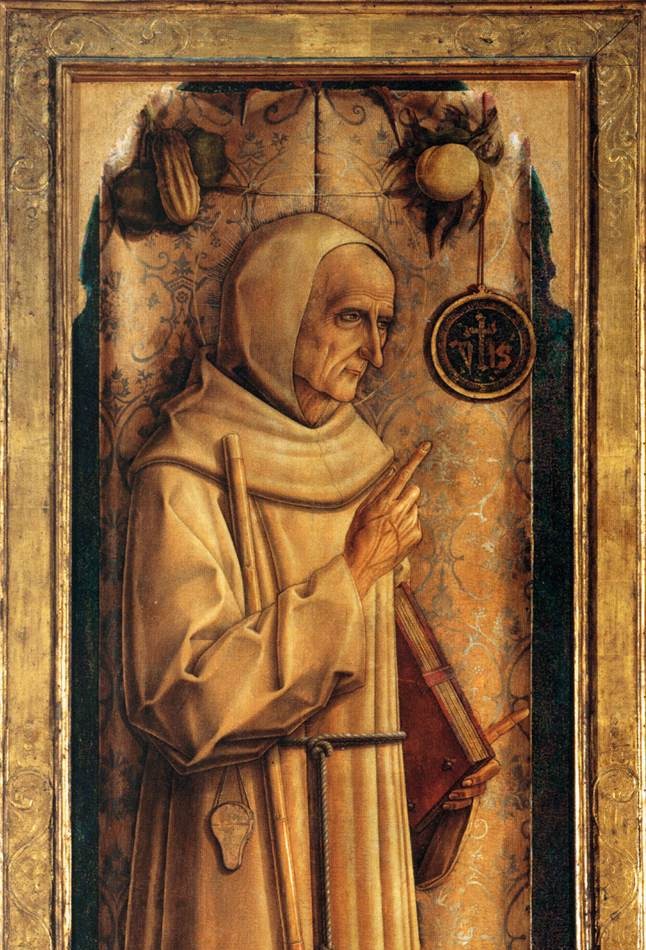
“Image: Detail of Carlo Crivelli, St. James of the Marches with Two Kneeling Donors, 1477, Louvre, Paris. Public domain, via Wikimedia Commons.” (source)

Beátus qui intéllegit super egénum et páuperem: in die mala liberábit eum Dóminus.
Psalm 40:2
Blessed is he that understandeth concerning the needy and the poor: the Lord will deliver him in the evil day.
About Today
On Saturday, November 28, the 1962 calendar has no feast: it is the Saturday after the twenty-fourth and last Sunday after Pentecost, a feria with green vestments. The Ordo lists no saint to honor and no commemoration. So today we honor a saint from the Roman Martyrology, which names St. James of the Marches on this day. The Mass is that of the preceding Sunday, as it is on most ferias at this season, and the Collect below is that Sunday’s, since the Martyrology saint has no Collect of his own. Saturday is also traditionally a day of Our Lady, and a votive Mass of the Blessed Virgin may be said.
His Life
St. James of the Marches was born Domenico Gangala in 1391 at Monteprandone, a small hill town in the Marches of central Italy, to a poor family. His uncle, a priest, saw that the boy was quick, and sent him to school. He went on to study law at the university of Perugia, where he took a doctorate in civil and canon law, and for a time he served as tutor in a noble house in Florence. A bright worldly career lay open to him.
He chose another road. About the year 1416 he asked to be received among the Friars Minor at the little church of the Portiuncula near Assisi, and he took the name James. He joined the Observants, the strict branch of the Franciscans, and there he lived in great poverty and severe penance. He was ordained priest about 1420, and he became a disciple and companion of St. Bernardine of Siena, whose devotion to the Holy Name of Jesus he made his own.
For the rest of a long life James was a preacher. He went on foot from town to town, first through Italy and then far beyond it, into Bohemia, Austria, Hungary, Dalmatia and Bosnia. His sermons drew crowds so large that he often had to preach in the open air, and he spoke in a plain and forceful way, calling sinners to repent and to make peace with their enemies. He was also sent as an inquisitor against heretics in several lands, and he wrote against the errors of his day. Popes used him as their envoy on missions of peace and of Church reform, and he served as a legate for the Holy See.
He had a particular love of the poor. In the cities of Italy, ordinary people were crushed by moneylenders who charged ruinous interest, and James, with other Franciscans, worked to set up the Monti di Pietà, charitable pawnshops that lent small sums to the needy at little or no cost. These institutions, which spread widely, were one of the great works of mercy of the Franciscan Order in the fifteenth century. He is often remembered with them.
For himself he asked nothing. He kept a hard rule of fasting and prayer, and he refused honors that were offered to him; it is recorded that he declined the archbishopric of Milan. He gave to the Order a good deal of his strength and wisdom and served it in positions of trust, but he remained, in his own mind, only a poor friar who preached.
In his old age he settled at the friary of Santa Maria la Nova in Naples, where he died on November 28, 1476, at about the age of eighty-five. Pope Urban VIII beatified him in 1624, and Pope Benedict XIII canonized him in 1726. The Roman Martyrology, in its notice for this day, speaks of him as a priest of the Order of Friars Minor and confessor, renowned for the austerity of his life, his apostolic preaching, and the many embassies he undertook for the Christian cause. His body is still venerated at Naples, and his home town of Monteprandone keeps his memory.
Patronage and Sacred Art
No widely recognized patronage is recorded for St. James of the Marches, though his home town of Monteprandone holds him dear. In art he is shown as an old Franciscan in the grey habit, often with a book, a staff and the monogram of the Holy Name of Jesus, which he preached after St. Bernardine. The picture above is a detail from a panel painted by Carlo Crivelli in 1477, now in the Louvre; at the saint’s feet kneel two small donors, who paid for the work.
A Lesson for Today
St. James teaches us that learning and talent are given for service. He could have made a fortune in the law; instead he spent himself on foot, preaching to sinners and building ways to help the poor. Today we can ask what gift we have, and whom it might help.
The Mass of the Day
Introit (Jeremias 29:11, 12, 14; Psalm 84:2)
Dicit Dóminus: Ego cógito cogitatiónes pacis, et non afflictiónis: invocábitis me, et ego exáudiam vos: et redúcam captivitátem vestram de cunctis locis. Ps. Benedixísti, Dómine, terram tuam: avertísti captivitátem Jacob. Glória Patri. Dicit Dóminus: Ego cógito cogitatiónes pacis, et non afflictiónis: invocábitis me, et ego exáudiam vos: et redúcam captivitátem vestram de cunctis locis.
The Lord says: I think thoughts of peace, and not of affliction. You shall call upon Me, and I will hear you; and I will bring back your captivity from all places. Ps. You have favored, O Lord, Your land; You have restored the well-being of Jacob. Glory be to the Father. The Lord says: I think thoughts of peace, and not of affliction. You shall call upon Me, and I will hear you; and I will bring back your captivity from all places.
Collect
Latin
Excita, quǽsumus, Dómine, tuórum fidélium voluntátes: ut, divíni óperis fructum propénsius exsequéntes; pietátis tuæ remédia majóra percípiant. Per Dóminum nostrum Iesum Christum Fílium tuum, qui tecum vivit et regnat in unitáte Spíritus Sancti, Deus, per ómnia sǽcula sæculórum. Amen.
English
Arouse, we beseech Thee, O Lord, the wills of Thy faithful people: that, by a more earnest search for the fruit of Thy divine work, they may receive more abundantly of the healing effects of Thy goodness. Through our Lord Jesus Christ, Thy Son, who liveth and reigneth with Thee in the unity of the Holy Ghost, God, world without end. Amen.
Epistle: Colossians 1:9-14
Léctio Epístolæ beáti Pauli Apóstoli ad Colossénses. Fratres: Non cessámus pro vobis orántes et postulántes, ut impleámini agnitióne voluntátis Dei, in omni sapiéntia et intelléctu spiritáli: ut ambulétis digne Deo per ómnia placéntes: in omni ópere bono fructificántes, et crescéntes in scientia Dei: in omni virtúte confortáti secúndum poténtiam claritátis ejus in omni patiéntia, et longanimitáte cum gáudio, grátias agentes Deo Patri, qui dignos nos fecit in partem sortis sanctórum in lúmine.
Brethren: We have been praying for you unceasingly, asking that you may be filled with knowledge of God’s will, in all spiritual wisdom and understanding. May you walk worthily of God and please Him in all things, bearing fruit in every good work and growing in the knowledge of God. May you be completely strengthened through His glorious power unto perfect patience and long-suffering; joyfully rendering thanks to God the Father, Who has made us worthy to share the lot of the saints in light.
Gospel: Matthew 24:15-22
In illo témpore: Dixit Jesus discípulis suis: Cum vidéritis abominatiónem desolatiónis, quæ dicta est a Daniéle Prophéta, stantem in loco sancto: qui legit, intélligat: tunc qui in Judǽa sunt, fúgiant ad montes: et qui in tecto, non descéndat tóllere áliquid de domo sua: et qui in agro, non revertátur tóllere túnicam suam. Væ autem prægnántibus et nutriéntibus in illis diébus. Oráte autem, ut non fiat fuga vestra in híeme vel sábbato. Erit enim tunc tribulátio magna, qualis non fuit ab inítio mundi usque modo, neque fiet.
At that time, Jesus said to His disciples: When you see the abomination of desolation, which was spoken of by Daniel the prophet, standing in the holy place – let him who reads understand – then let those who are in Judea flee to the mountains; and let him who is on the housetop not go down to take anything from his house; and let him who is in the field not turn back to take his cloak. But woe to those who are with child, or have infants at the breast in those days! But pray that your flight may not be in the winter, or on the Sabbath. For then there will be great tribulation, such as has not been from the beginning of the world until now, nor will be.
Sancte Iacóbe de Marchia, ora pro nobis.
St. James of the Marches, pray for us.
Roman Martyrology
Apud Corínthum natális sancti Sósthenis, ex beáti Pauli Apóstoli discípulis; cuius mentiónem facit idem Apóstolus Corínthiis scribens. Ipse autem Sósthenes, ex príncipe Synagógæ convérsus ad Christum, fídei suæ primórdia, ante Galliónem Procónsulem ácriter verberátus, præcláro inítio consecrávit.
At Corinth, the birthday of St. Sosthenes, one of the disciples of the blessed Apostle Paul, who mentions him when writing to the Corinthians. Sosthenes, converted to Christ from being ruler of the synagogue, consecrated the beginning of his faith with a glorious start, being severely scourged before the proconsul Gallio.
Romæ sancti Rufi, quem, cum omni família sua, Christi Mártyrem Diocletiánus fecit.
At Rome, St. Rufus, whom Diocletian, together with all his household, made a martyr of Christ.
In Africa sanctórum Mártyrum Papiniáni et Mansuéti Episcopórum, qui, témpore Wandálicæ persecutiónis, sub Rege Ariáno Genseríco, pro fídei cathólicæ defensióne, candéntibus ferri láminis toto córpore adústi, gloriósum agónem consummárunt. Quo étiam témpore álii novem sancti Epíscopi, scílicet Valeriánus, Urbánus, Crescens, Eustáchius, Crescónius, Crescentiánus, Felix, Hortulánus et Florentiánus, damnáti exsílio, cursum vitæ suæ implevérunt.
In Africa, the holy martyrs Papinianus and Mansuetus, bishops, who in the time of the Vandal persecution, under the Arian king Genseric, were burned over their whole bodies with red-hot plates of iron in defense of the Catholic faith, and so finished their glorious struggle. At that same time nine other holy bishops, namely Valerian, Urban, Crescens, Eustachius, Cresconius, Crescentianus, Felix, Hortulanus and Florentianus, were condemned to exile and there ended the course of their lives.
Constantinópoli sanctórum Mártyrum Stéphani iunióris, Basilíi, Petri, Andréæ, et Sociórum trecentórum et trigínta novem Monachórum; qui, sub Constantíno Coprónymo, pro sanctárum Imáginum cultu váriis excruciáti supplíciis, veritátem cathólicam effúso sánguine confirmárunt.
At Constantinople, the holy martyrs Stephen the Younger, Basil, Peter, Andrew, and their three hundred and thirty-nine companion monks, who under Constantine Copronymus were tormented with various punishments for the veneration of the holy Images, and confirmed the Catholic truth by the shedding of their blood.
Neápoli, in Campánia, deposítio sancti Iacóbi Picéni, Sacerdótis ex Ordine Minórum et Confessóris, vitæ asperitáte, apostólica prædicatióne ac plúribus pro re Christiána óbitis legatiónibus præclári; quem Benedíctus Décimus tértius, Póntifex Máximus, Sanctórum fastis adiúnxit.
At Naples, in Campania, the burial of St. James of the Marches, priest of the Order of Friars Minor and confessor, renowned for the austerity of his life, his apostolic preaching, and the many embassies he undertook for the Christian cause; Pope Benedict XIII added him to the calendar of the Saints.
Et álibi aliórum plurimórum sanctórum Mártyrum et Confessórum, atque sanctárum Vírginum.
And elsewhere many other holy martyrs, confessors and virgins.
Also honored today: St. Sosthenes, disciple of St. Paul, St. Rufus, martyr, and St. Stephen the Younger and his companions, monks.