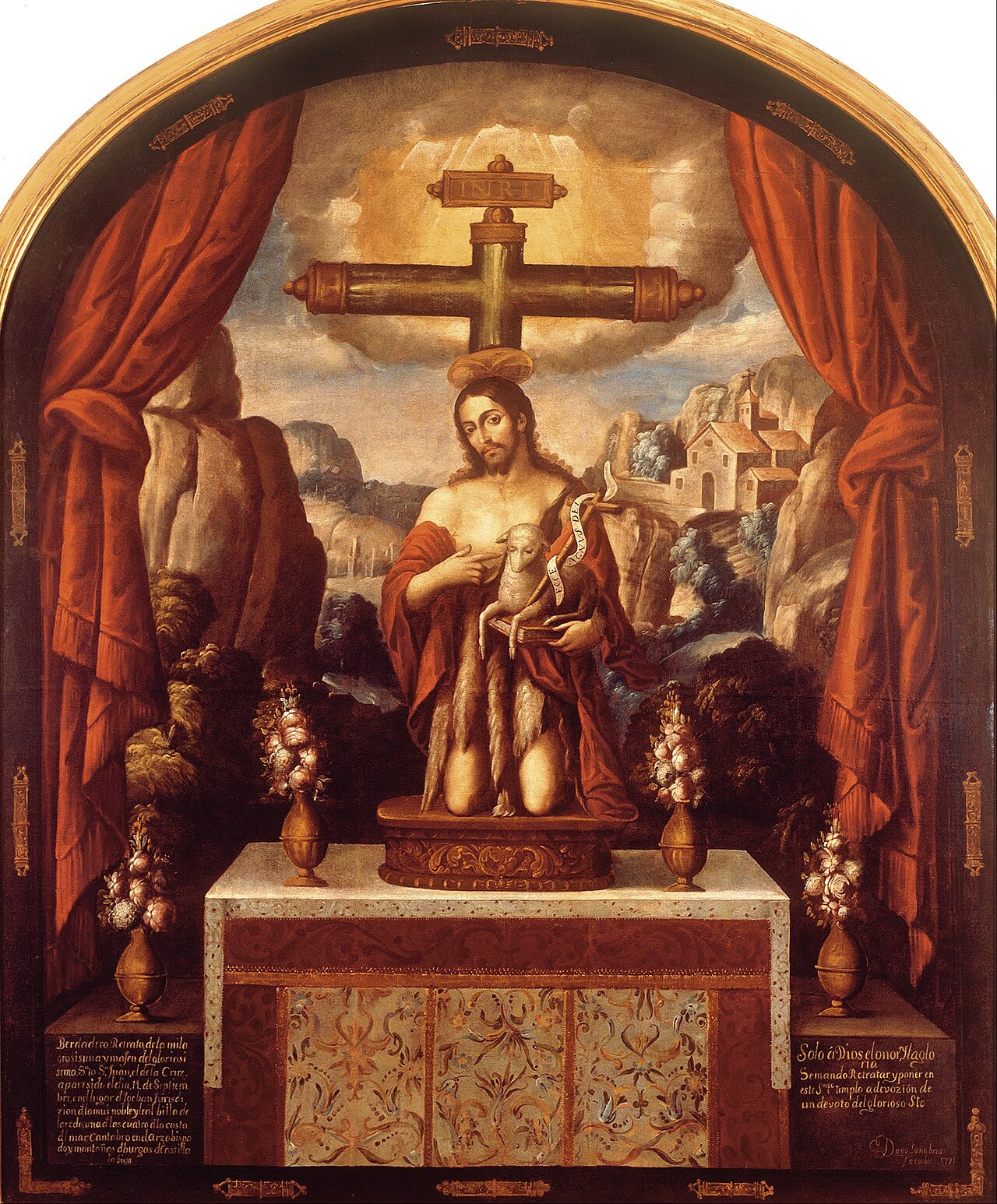
Image: Diego de Sanabria, San Juan de la Cruz, 17th century. Museo Nacional de Arte, Mexico City. Public domain, via Wikimedia Commons. (source)

Mihi autem absit gloriári, nisi in cruce Dómini nostri Iesu Christi: per quem mihi mundus crucifíxus est, et ego mundo.
Galatians 6:14
But God forbid that I should glory, save in the cross of our Lord Jesus Christ, by whom the world is crucified to me, and I to the world.
About Today
On Tuesday, November 24, the 1962 calendar keeps the feast of St. John of the Cross, Confessor and Doctor of the Church, a feast of the third class, with white vestments and a commemoration of St. Chrysogonus, martyr. The Mass is the Mass of a Doctor of the Church.
His Life
Juan de Yepes was born in 1542 at Fontiveros, a small town near Avila in Spain. His father, Gonzalo, came from a good family but was cut off by them for marrying a poor silk weaver, Catalina Alvarez, and he died while Juan was still a little child. The widow was left with three sons and almost nothing, and she moved from town to town looking for work. Juan grew up in real poverty. At Medina del Campo he learned a trade, served the sick in the hospital of the poor, and studied with the Jesuits, who saw how quick and thoughtful he was.
In 1563 he entered the Carmelite house at Medina and took the name John of St. Matthias. He was sent to study at Salamanca, and was ordained priest in 1567. He then wished for a stricter life and was thinking of joining the Carthusians, but that same year he met St. Teresa of Jesus at Medina del Campo. She was working to bring her Order back to its first rule of prayer and poverty, and she asked him to help her. On November 28, 1568, he began the first house of the reform for men, a poor little farmhouse at Duruelo, and from then on he was known as John of the Cross.
The reform was not welcome to everyone. In December 1577 some of the friars who opposed it seized him at Avila and carried him to Toledo, where he was shut up for about nine months in a tiny, dark cell. He was beaten before the community, fed on bread and scraps of fish, and given almost no light. Yet in that prison, in the dark, he composed some of the finest poems in the Spanish language. In August 1578 he made his escape by night through a high window and found shelter with the Teresian nuns.
After his escape he held office in Andalusia, serving as prior at Granada, Baeza and elsewhere, while he wrote the books that made him a master of the spiritual life: the Ascent of Mount Carmel, the Dark Night, the Spiritual Canticle and the Living Flame of Love. In them he teaches that the soul can be united to God only by love, and that love must be freed from every attachment that keeps us from Him. He asked for nothing more than to suffer and to be despised for Christ’s sake.
Toward the end of his life he was again treated harshly by some of his own brethren, and he was sent away to the lonely house at Ubeda, where he fell ill with a painful infection and fever. He bore his sufferings in patience and asked pardon of those who cared for him. He died there, in the night of December 13 to 14, 1591, at the age of forty-nine, after asking that the Psalms of the Office be read to him. The Church remembers his birthday into heaven on December 14 in the Martyrology.
He was beatified in 1675 and canonized in 1726 by Pope Benedict XIII. In 1926 Pope Pius XI declared him a Doctor of the Church. His writings are still the surest guide for souls who pray, because they hold nothing back about the cost of loving God: He is to be loved above every created thing.
Patronage and Sacred Art
St. John of the Cross is the patron of mystics and contemplatives, and Pope Pius XII named him patron of Spanish poets in 1952. In art he wears the brown habit and white mantle of the Carmelites. He holds a cross, often with a book or pen, and sometimes he looks upon the crucified Christ. A well-known drawing made by the saint himself, after a vision, shows Christ on the Cross seen from above. The painting above, by Diego de Sanabria, shows him in his Carmelite habit.
A Lesson for Today
St. John did not seek comfort, honor, or even spiritual consolations. When Our Lord asked him what reward he wanted for his labors, he is said to have answered, “To suffer and to be despised for Thee.” We may not be asked for so much. But we can learn from him to bear a small cross without complaining, to let go of the things that keep us from prayer, and to love God first, since everything else will be rightly ordered when He is first.
The Mass of the Day
Introit (Ecclesiasticus 15:5; Psalm 91:2)
In médio Ecclésiæ apéruit os eius: et implévit eum Dóminus spíritu sapiéntiæ et intelléctus: stolam glóriæ índuit eum. Ps. Bonum est confitéri Dómino: et psállere nómini tuo, Altíssime. Glória Patri. In médio Ecclésiæ apéruit os eius: et implévit eum Dóminus spíritu sapiéntiæ et intelléctus: stolam glóriæ índuit eum.
In the midst of the church he opened his mouth: and the Lord filled him with the spirit of wisdom and understanding: he clothed him with a robe of glory. Ps. It is good to give praise to the Lord: and to sing to thy name, O most High. Glory be to the Father. In the midst of the church he opened his mouth: and the Lord filled him with the spirit of wisdom and understanding: he clothed him with a robe of glory.
Collect
Latin
Deus, qui sanctum Ioánnem Confessórem tuum atque Doctórem perféctæ sui abnegatiónis et Crucis amatórem exímium effecísti: concéde; ut, eius imitatióni iúgiter inhæréntes, glóriam assequámur ætérnam. Per Dóminum nostrum Iesum Christum, Fílium tuum, qui tecum vivit et regnat in unitáte Spíritus Sancti, Deus, per ómnia sǽcula sæculórum. Amen.
English
O God, who didst make blessed John, Thy confessor and doctor, an extraordinary lover of perfect self-denial and of the Cross: grant that, ever following his example, we may attain to everlasting glory. Through our Lord Jesus Christ, Thy Son, who liveth and reigneth with Thee in the unity of the Holy Ghost, God, world without end. Amen.
Epistle: 2 Timothy 4:1-8
Caríssime: Testíficor coram Deo, et Iesu Christo, qui iudicatúrus est vivos et mórtuos, per advéntum ipsíus et regnum eius: prǽdica verbum, insta opportúne, importúne: árgue, óbsecra, íncrepa in omni patiéntia, et doctrína.
Dearly beloved: I charge thee, before God and Jesus Christ, who shall judge the living and the dead, by his coming, and his kingdom: Preach the word: be instant in season, out of season: reprove, entreat, rebuke in all patience and doctrine.
Gospel: Matthew 5:13-16
In illo témpore: Dixit Iesus discípulis suis: Vos estis sal terræ. Quod si sal evanúerit, in quo saliétur? Ad níhilum valet ultra, nisi ut mittátur foras, et conculcétur ab homínibus. Vos estis lux mundi.
At that time Jesus said to His disciples: You are the salt of the earth. But if the salt lose its savour, wherewith shall it be salted? It is good for nothing any more but to be cast out, and to be trodden on by men. You are the light of the world.
Sancte Ioánnes a Cruce, ora pro nobis.
St. John of the Cross, pray for us.
Roman Martyrology
Sancti Ioánnis a Cruce Presbýteri, Confessóris et Ecclésiæ Doctóris, sanctæ Terésiæ in Carmelitárum reformatióne sócii, cuius dies natális décimo nono Kaléndas Ianuárii recensétur.
Saint John of the Cross, priest, confessor and Doctor of the Church, companion of St. Teresa in the reform of the Carmelites, whose birthday is kept on the nineteenth day before the Kalends of January (December 14).
Eódem die natális sancti Chrysógoni Mártyris, qui, post longa víncula et cárceres pro constantíssima Christi confessióne tolerátos, Aquiléiam, iubénte Diocletiáno, perdúctus, tandem, cæsus cápite et in mare proiéctus, martýrium consummávit.
On the same day, the birthday of St. Chrysogonus, martyr, who after long chains and imprisonment endured for his steadfast confession of Christ, was led to Aquileia by order of Diocletian, and at last was beheaded and cast into the sea, and so completed his martyrdom.
Also honored today: St. Chrysogonus, martyr, SS. Flora and Mary, virgins and martyrs, and St. Protasius, bishop.