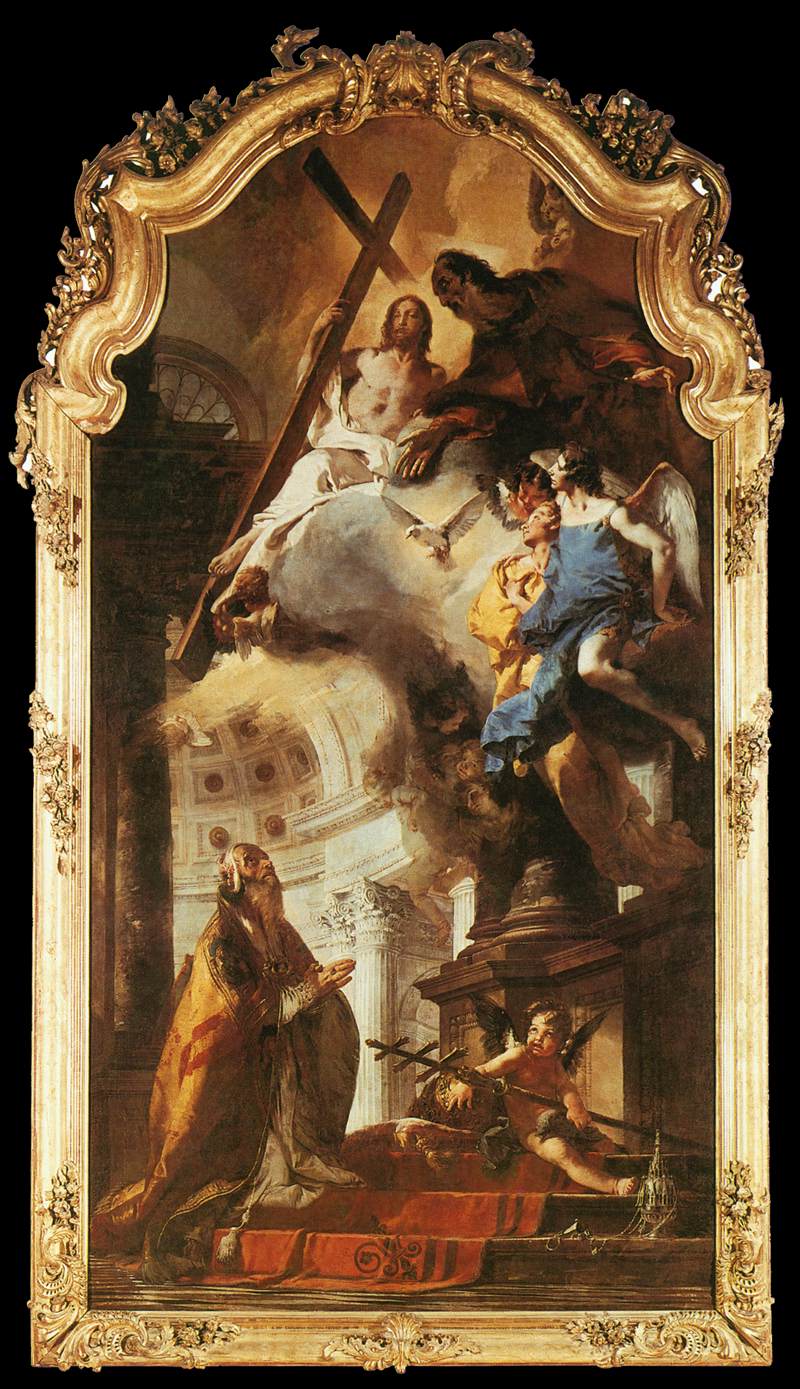
Image: Giovanni Battista Tiepolo, Pope St. Clement Adoring the Trinity, 1730s. Alte Pinakothek, Munich. Public domain, via Wikimedia Commons. (source)

Etiam rogo et te, germáne compar, ádiuva illas, quæ mecum laboravérunt in Evangélio cum Cleménte et céteris adiutóribus meis, quorum nómina sunt in libro vitæ.
Philippians 4:3
And I entreat thee also, my sincere companion, help those women who have laboured with me in the gospel, with Clement, and the rest of my fellow labourers, whose names are in the book of life.
About Today
On Monday, November 23, the 1962 calendar keeps the feast of St. Clement I, Pope and Martyr, a feast of the third class, with red vestments and a commemoration of St. Felicity, martyr. The Mass is the Mass of a martyr pope, with its own Introit and Collect.
His Life
St. Clement was the third successor of St. Peter in the See of Rome, after Linus and Anacletus (St. Irenaeus lists them in that order, and some old writers count Clement as the fourth, since they disagree about how the first names fall). Tertullian reports that Peter himself ordained him. Origen and Eusebius, followed by many of the Fathers, believed that he is the Clement whom St. Paul names in his Letter to the Philippians among his fellow-workers “whose names are in the book of life.” The Church has long held him in great honor, and his name is still said in the Roman Canon of the Mass, in the prayer Communicantes.
Very little else is known for certain about his early life. Ancient tradition says that he was a Roman of good family and that he had been converted by the preaching of the Apostles, perhaps by Peter and Paul in Rome. He became bishop of the Church there, probably in the last decade of the first century, during the reign of the Emperor Domitian, when the Christians suffered much.
His one surviving work is a long letter written in the name of the Church of Rome to the Church of Corinth, probably about the year 96. The Corinthians had driven out some of their lawful presbyters, and Clement wrote to restore peace. He urges humility and obedience, reminds them of the order that Christ gave to His Church through the Apostles and their successors, and calls them back to charity. The letter was so loved that it was read aloud at Mass in Corinth for generations, and some early Christians even placed it near the New Testament writings. For historians it is also one of the earliest witnesses to the authority of the Roman Church, which spoke here to settle a quarrel in a distant city while St. John, the last of the Apostles, was perhaps still living.
Later accounts, handed down in the Acts of St. Clement and repeated in the Roman Martyrology, say that during the persecution of Trajan he was banished to the quarries near Chersonesus on the Black Sea, in the Crimea. There, it is told, he found many Christians condemned to hard labor and comforted them, and a spring of water appeared for their thirst. Because so many pagans were converted, the emperor ordered that he be thrown into the sea with an anchor tied to his neck. These accounts were written long after his death, and scholars treat their details with caution, but they are the reason that the anchor is his emblem, and that the Church honors him as a martyr.
The same tradition says that, when the tide went out each year, the sea drew back and left a small shrine where his body lay. In the year 861 St. Cyril, the apostle of the Slavs, recovered what were believed to be his relics, and with his brother St. Methodius brought them to Rome in 868, where Pope Adrian II received them with great honor. They were laid in the ancient Basilica of San Clemente, which stands on the site of a church that already bore his name in the fourth century, and where they remain today.
St. Jerome, writing about the year 392, already mentions the church of Rome that bore Clement’s name. The Church has always seen in him the model of a shepherd who governs with humility, writes to keep peace among the flock, and gives his life for the faith.
Patronage and Sacred Art
St. Clement is the patron saint of mariners and of those who work in marble, and the anchor is his sign in art. He is shown as a pope in tiara and cope, holding or standing beside an anchor, sometimes with a fountain, recalling the spring of water in the story of his exile. The great Basilica of San Clemente in Rome and the church of St. Clement Danes in London, both dedicated to him, keep his memory alive. The painting above, by the Venetian master Giovanni Battista Tiepolo, shows him in glory, adoring the Holy Trinity.
A Lesson for Today
St. Clement did not write to the Corinthians to show off his authority, but to bring back peace to a divided Church. He asks them to be humble, to submit to those lawfully set over them, and to let love bind them together. In our own families, parishes, and workplaces, quarrels grow quickly and are slow to heal. His letter reminds us that peace begins when one person decides to be humble first, and that a Christian stays steady, like a ship at anchor, only by holding fast to Christ and to His Church.
The Mass of the Day
Introit (Isaias 59:21; 56:7; Psalm 111:1)
Dicit Dóminus: Sermónes mei, quos dedi in os tuum, non defícient de ore tuo: et múnera tua accépta erunt super altáre meum. Ps. Beátus vir, qui timet Dóminum: in mandátis eius cupit nimis. Glória Patri. Dicit Dóminus: Sermónes mei, quos dedi in os tuum, non defícient de ore tuo: et múnera tua accépta erunt super altáre meum.
The Lord saith: My words which I have put in thy mouth shall not depart out of thy mouth, and thy gifts shall be acceptable upon my altar. Ps. Blessed is the man that feareth the Lord: he delighteth exceedingly in His commandments. Glory be to the Father. The Lord saith: My words which I have put in thy mouth shall not depart out of thy mouth, and thy gifts shall be acceptable upon my altar.
Collect
Latin
Deus, qui nos ánnua beáti Cleméntis Mártyris tui atque Pontíficis sollemnitáte lætíficas: concéde propítius; ut, cuius natalítia cólimus, virtútem quoque passiónis imitémur. Per Dóminum nostrum Iesum Christum, Fílium tuum, qui tecum vivit et regnat in unitáte Spíritus Sancti, Deus, per ómnia sǽcula sæculórum. Amen.
English
O God, who dost gladden us by the yearly feast of blessed Clement, Thy martyr and pontiff: mercifully grant that we who keep his birthday may also imitate the courage of his passion. Through our Lord Jesus Christ, Thy Son, who liveth and reigneth with Thee in the unity of the Holy Ghost, God, world without end. Amen.
Epistle: Philippians 3:17-19
Fratres: Imitatóres mei estóte, et observáte eos, qui ita ámbulant, sicut habétis formam nostram. Multi enim ámbulant, quos sæpe dicébam vobis – nunc autem et flens dico – inimícos Crucis Christi: quorum finis intéritus: quorum Deus venter est: et glória in confusióne ipsórum, qui terréna sápiunt.
Be ye followers of me, brethren, and observe them who walk so as you have our model. For many walk, of whom I have told you often (and now tell you weeping) that they are enemies of the cross of Christ: whose end is destruction; whose god is their belly; and whose glory is in their shame; who mind earthly things.
Gospel: Luke 14:26-27
In illo témpore: Dixit Iesus turbis: Si quis venit ad me, et non odit patrem suum, et matrem, et uxórem, et fílios, et fratres, et soróres, adhuc autem et ánimam suam, non potest meus esse discípulus. Et qui non bájulat crucem suam, et venit post me, non potest meus esse discípulus.
At that time Jesus said to the multitudes: If any man come to me, and hate not his father, and mother, and wife, and children, and brethren, and sisters, yea and his own life also, he cannot be my disciple. And whosoever doth not carry his cross and come after me, cannot be my disciple.
Sancte Cleméns, ora pro nobis.
St. Clement, pray for us.
Roman Martyrology
Natális sancti Cleméntis Primi, Papæ et Mártyris, qui, tértius post beátum Petrum Apóstolum, Pontificátum ténuit, et, in persecutióne Traiáni, apud Chersonésum relegátus, ibi, alligáta ad eius collum ánchora, præcipitátus in mare, martýrio coronátur. Ipsíus autem corpus, Hadriáno Secúndo Summo Pontífice, a sanctis Cyríllo et Methódio frátribus Romam translátum, in Ecclésia quæ eius nómine ántea fúerat exstrúcta, honorífice recónditum est.
The birthday of St. Clement I, Pope and Martyr, who held the Pontificate as the third after the blessed Apostle Peter, and who, banished to Chersonesus in the persecution of Trajan, was there cast into the sea with an anchor tied to his neck, and was crowned with martyrdom. His body was afterward translated to Rome by the holy brothers Cyril and Methodius, in the pontificate of Hadrian II, and was honorably laid to rest in the church that had earlier been built in his name.
Romæ sanctæ Felicitátis Mártyris, septem filiórum Mártyrum matris; quæ, post eos, iubénte Marco Antoníno Imperatóre, decolláta est pro Christo.
At Rome, St. Felicity, martyr, the mother of seven martyred sons, who after them was beheaded for Christ by order of the Emperor Marcus Antoninus.
Also honored today: St. Felicity, martyr, St. Amphilochius, bishop, and St. Trudo, priest and confessor.