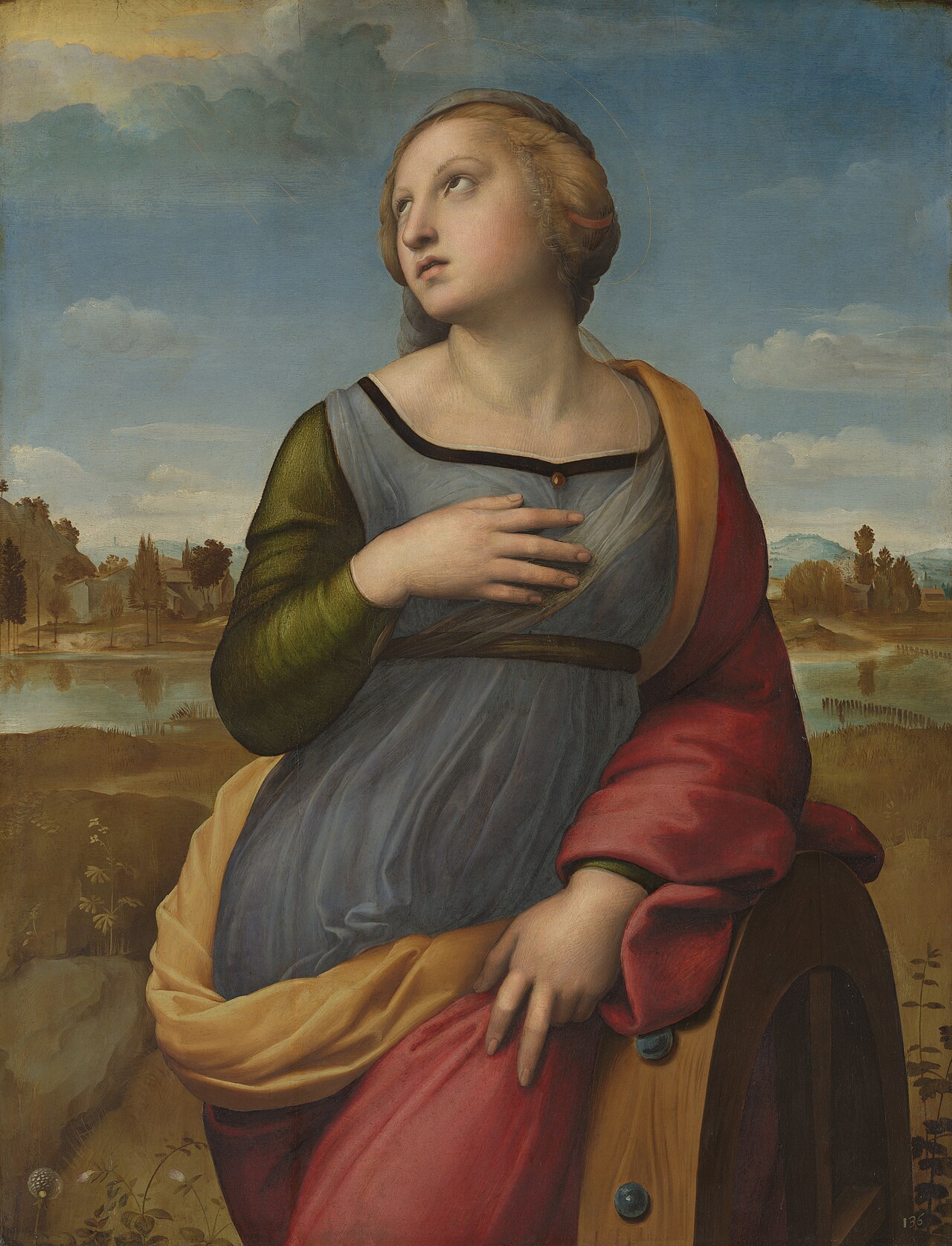
Image: Raphael, Saint Catherine of Alexandria, c. 1507-1508. The National Gallery, London. Public domain, via Wikimedia Commons. (source)

Et loquébar in testimóniis tuis in conspéctu regum, et non confundébar.
Psalm 118:46 (Vulgate numbering)
I spoke of thy testimonies before kings: and I was not ashamed.
About Today
On Wednesday, November 25, the 1962 calendar keeps the feast of St. Catherine of Alexandria, Virgin and Martyr, a feast of the third class, with red vestments. There is no other commemoration today. The Mass is the Mass of a virgin and martyr, with a Collect proper to St. Catherine.
Her Life
St. Catherine of Alexandria is one of the most loved martyrs of the early Church, and the Roman Martyrology records her under this day: at Alexandria, the holy virgin and martyr Catherine, who for her confession of the Christian faith under the Emperor Maximinus was thrown into prison, scourged for a very long time, and at last finished her martyrdom by beheading. It must be said plainly that the early records about her are scanty, and the fuller story comes from later accounts, such as the Golden Legend. The Church has honored her since ancient times, and her name was kept in the Roman calendar for centuries.
According to the traditional account, Catherine was a young woman of Alexandria, of noble birth, and gifted with a keen mind. She studied the learning of her day and was known for her wisdom. When she came to know Christ and was baptized, she gave herself wholly to Him and chose to remain a virgin for His sake.
When the Emperor came to Alexandria and ordered the Christians to offer sacrifice to the idols, Catherine went boldly before him and spoke in defense of the faith. The Emperor, amazed at her courage, gathered fifty of the wisest philosophers to argue against her. The tradition says that she answered them so well that many of them were won to the faith, and that they gave their lives for Christ.
Catherine herself was then cast into prison and cruelly scourged. The tradition adds that the Emperor’s wife and an officer of the court visited her there, and that they too believed in Christ and died for Him. A wheel set with sharp spikes was prepared to put her to death, but it was broken, and Catherine was finally beheaded. This is why the wheel, a “Catherine wheel,” is her sign.
The Roman Martyrology adds that her body was carried by angels to Mount Sinai, where Christians came in great numbers to honor it. The monastery at the foot of Sinai, founded in the days of the Emperor Justinian, bears her name to this day, and pilgrims and crusaders carried her devotion all over Europe. In the Middle Ages she was counted among the Fourteen Holy Helpers, and she was among the voices that St. Joan of Arc said she heard.
Whatever we think of the details of the later legend, the Church holds up the heart of the story: a young woman who spoke of the truth before kings and was not ashamed, and who loved Christ more than her own life. The Collect of her Mass ties her to Mount Sinai, where the Law was given to Moses, and asks that by her prayers we may come to the mountain which is Christ.
Patronage and Sacred Art
St. Catherine is the patron of philosophers, students, teachers and librarians, and of wheelwrights and millers because of the wheel. She is one of the Fourteen Holy Helpers. In art she is shown as a young woman, often crowned, with a wheel (usually broken) beside her, a palm of martyrdom, a book, and sometimes a sword. Many painters, among them Raphael, Caravaggio and Memling, have shown her. The painting above is by Raphael, showing her leaning on the wheel and looking up to heaven.
A Lesson for Today
St. Catherine used the gifts of her mind for the truth, and she was not ashamed to speak of Christ before those in power. We are not asked to argue with an Emperor, but we are asked to be faithful in small things: to speak the truth kindly when it is not welcome, to learn our faith well enough to give a reason for it, and to prefer Christ to the opinions of men. Like the wise virgins of the Gospel, we should keep our lamps trimmed and oil in our vessels.
The Mass of the Day
Introit (Psalm 118:46-47, 1)
Loquébar de testimóniis tuis in conspéctu regum, et non confundébar: et meditábar in mandátis tuis, quæ diléxi nimis. Ps. Beáti immaculáti in via: qui ámbulant in lege Dómini. Glória Patri. Loquébar de testimóniis tuis in conspéctu regum, et non confundébar: et meditábar in mandátis tuis, quæ diléxi nimis.
I spoke of thy testimonies before kings, and I was not ashamed: and I meditated on thy commandments, which I loved exceedingly. Ps. Blessed are the undefiled in the way: who walk in the law of the Lord. Glory be to the Father. I spoke of thy testimonies before kings, and I was not ashamed: and I meditated on thy commandments, which I loved exceedingly.
Collect
Latin
Deus, qui dedísti legem Móysi in summitáte montis Sínai, et in eódem loco per sanctos Angelos tuos corpus beátæ Catharínæ Vírginis et Mártyris tuæ mirabíliter collocásti: præsta, quǽsumus; ut, eius méritis et intercessióne, ad montem, qui Christus est, perveníre valeámus. Qui tecum vivit et regnat in unitáte Spíritus Sancti, Deus, per ómnia sǽcula sæculórum. Amen.
English
O God, who gavest the law to Moses on the summit of Mount Sinai, and in the same place by Thy holy Angels didst wonderfully place the body of blessed Catherine, Thy virgin and martyr: grant, we beseech Thee, that by her merits and intercession we may be able to come to the mountain which is Christ. Who livest and reignest with Thee in the unity of the Holy Ghost, God, world without end. Amen.
Epistle: Ecclesiasticus 51:1-3
Léctio libri Sapiéntiæ. Confitébor tibi, Dómine, Rex, et collaudábo te Deum, Salvatórem meum. Confitébor nómini tuo: quóniam adiútor et protéctor factus es mihi, et liberásti corpus meum a perditióne, a láqueo línguæ iníquæ et a lábiis operántium mendácium, et in conspéctu astántium factus es mihi adiútor.
I will give thanks to thee, O Lord, O King, and I will praise thee, O God my Saviour. I will give thanks to thy name: for thou hast been a helper and protector to me, and hast preserved my body from destruction, from the snare of an unjust tongue, and from the lips of them that forge lies, and in the sight of them that stood by, thou hast been my helper.
Gospel: Matthew 25:1-4
In illo témpore: Dixit Iesus discípulis suis parábolam hanc: Símile erit regnum cælórum decem virgínibus: quæ, accipiéntes lámpades suas, exiérunt óbviam sponso et sponsæ. Quinque autem ex eis erant fátuæ, et quinque prudéntes: sed quinque fátuæ, accéptis lampádibus, non sumpsérunt óleum secum: prudéntes vero accepérunt óleum in vasis suis cum lampádibus.
At that time Jesus spoke this parable to His disciples: The kingdom of heaven shall be like to ten virgins, who, taking their lamps, went out to meet the bridegroom and the bride. And five of them were foolish, and five wise. But the five foolish, having taken their lamps, did not take oil with them: but the wise took oil in their vessels with the lamps.
Sancta Catharína, ora pro nobis.
St. Catherine, pray for us.
Roman Martyrology
Alexandríæ sanctæ Catharínæ, Vírginis et Mártyris, quæ, ob fídei Christiánæ confessiónem, sub Maximíno Imperatóre, in cárcerem trusa, et póstmodum scorpiónibus diutíssime cæsa, tandem cápitis obtruncatióne martýrium complévit. Ipsíus corpus, in montem Sínai mirabíliter ab Angelis delátum, ibídem, frequénti Christianórum concúrsu, pia veneratióne cólitur.
At Alexandria, the holy virgin and martyr Catherine, who for her confession of the Christian faith under the Emperor Maximinus was thrown into prison and afterward scourged for a very long time, and at last completed her martyrdom by beheading. Her body, wonderfully carried by Angels to Mount Sinai, is honored there with pious veneration by a frequent concourse of Christians.
Romæ sancti Móysis, Presbýteri et Mártyris; quem, cum áliis deténtum in cárcere, sanctus Cypriánus per lítteras sæpe est consolátus. Ipse autem Móyses, cum non tantum advérsus Gentíles, sed étiam advérsus schismáticos et hæréticos Novatiános infrácto ánimo stetísset, demum (ut sanctus Cornélius Papa testátur), in persecutióne Décii, exímio et admirábili martýrio decorátus est.
At Rome, St. Moses, priest and martyr; St. Cyprian often consoled him by letter when he was held in prison with others. Moses stood with unbroken spirit not only against the heathen but also against the Novatian schismatics and heretics, and at last, as Pope St. Cornelius testifies, in the persecution of Decius he was crowned with a noble and admirable martyrdom.
Antiochíæ sancti Erásmi Mártyris.
At Antioch, St. Erasmus, martyr.
Cæsaréæ, in Cappadócia, pássio sancti Mercúrii mílitis, qui custodiéntis se Angeli patrocínio et bárbaros vicit, et Décii sævítiam superávit; multísque auctus tormentórum trophǽis, martýrio coronátus migrávit in cælum.
At Caesarea in Cappadocia, the passion of St. Mercurius, a soldier, who by the protection of the Angel guarding him overcame the barbarians and the cruelty of Decius; and, enriched with many trophies of torments, was crowned with martyrdom and passed to heaven.
In Æmília, Itáliæ província, sanctæ Iucúndæ Vírginis.
In Emilia, a province of Italy, St. Jucunda, virgin.
Et álibi aliórum plurimórum sanctórum Mártyrum et Confessórum, atque sanctárum Vírginum.
And elsewhere many other holy martyrs, confessors and virgins.
Also honored today: St. Moses, priest and martyr, St. Erasmus, martyr, and St. Mercurius, soldier and martyr.